Field Notes · June 16, 2026
How to See the Montserrat Oriole, the Bird Found Only on Montserrat
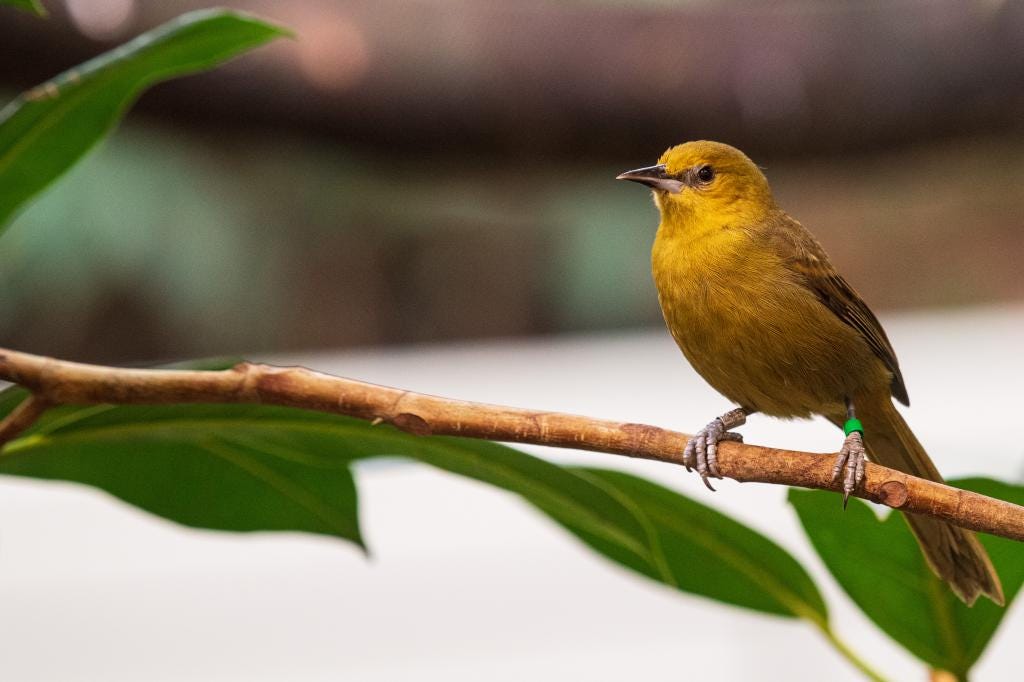
The Montserrat Oriole (Icterus oberi) is one of the rarest birds in the Caribbean and the only bird species on earth that lives nowhere else. Not St. Kitts. Not Antigua. Not anywhere else in the Lesser Antilles. Just here, on one small island in the West Indies. For serious birders building a Caribbean life list, the Montserrat Oriole is a must-see lifer that can only be added to your sightings here. This is everything you need to know about how to find one.
The bird itself
A medium-sized songbird of the icterid family, related to American orioles and blackbirds. The male is striking: glossy black across the back, head, wings, and tail, with a vivid yellow underbelly that catches the light when he moves through the canopy. The female is softer, an olive-yellow throughout. Both share a clear, descending whistle that travels well through the mountain forest. Once you’ve heard it, you recognise it everywhere.
Why birders are flying to Montserrat to see it
Endemic species, birds that live in just one location, are some of the most prized sightings in birding. The Montserrat Oriole exists nowhere else on the planet. You cannot find this bird on another island. You cannot see it in any zoo. You have to come to Montserrat.
It is also one of the rarest endemic birds in the Caribbean. The wild population is estimated at just over 500 adults. Every sighting is genuinely rare, and adding it to a Caribbean life list requires a trip to one specific island.
For experienced birders chasing endemics across the Lesser Antilles, the Montserrat Oriole is one of the most important species on the route. For new birders, seeing your first endemic flash of black-and-yellow through the canopy is a moment that hooks you for life.
A bird that nearly disappeared
In 1995, the Soufrière Hills Volcano on Montserrat erupted, and the eruptive period continued for years. Two-thirds of the Oriole’s forest habitat in the south of the island was destroyed by pyroclastic flows, volcanic ash, and acid rain. The population crashed. For a moment, it looked like the bird that gives Montserrat its national symbol might not survive its national disaster.
A coalition formed in response: the Department of Environment Montserrat, the Royal Society for the Protection of Birds, the Durrell Wildlife Conservation Trust, and dozens of local volunteers. The work focused on three things, protecting the Centre Hills as the last great stronghold of native forest (designated a protected area in 2014), managing the invasive feral pig population that was disturbing nest sites, and tracking the population year over year to understand which habitats and rainfall patterns the birds responded to.
The volcanic activity subsided after 2010. Conservation work continues today. The species lives, and the Centre Hills remains its stronghold.
Watch the Montserrat Oriole, up close
Three short videos from recent guided walks show the Oriole closer than most birders ever get to see one in the wild:
Caption: This bird lives in one place on earth. Montserrat.
Caption: Montserrat (West Indies) Oriole flapping its wings
One of these videos picked up over 1,300 views in its first 24 hours on YouTube, the kind of attention small-island endemic birds almost never get.
More videos of the Oriole, the three Caribbean hummingbirds, and other rare Centre Hills birds are on Scriber’s YouTube channel.
Where to see the Montserrat Oriole
The bird is most reliably found in the Centre Hills, the protected mountainous heart of the island. The forest there ranges from semi-evergreen at lower elevations to montane rainforest in the high cloud zones, exactly the structure the Oriole prefers.
Three trails within Centre Hills give a real chance of a sighting:
Book The Oriole Walkway Nature Trail. Named for the bird itself, it runs through the heart of the Oriole’s range and is one of the most reliable spots on earth to see Icterus oberi in the wild.
Book The Blackwood Allen Trail. Crosses more open forest with good edge habitat for spotting the Oriole and several other Caribbean endemics on the same walk.
Book The Cot Trail. Passes through areas where the Oriole has been recorded regularly, often with cooperative birds early in the morning.
When to go and what to bring
Best time of day. Early morning, 6:00 to 9:00 AM. The birds are most vocal and most active in the cool of the morning, before the heat of the day quiets the forest. By midday they retreat to shaded canopy.
Best time of year. The breeding season runs roughly March to August. Males are especially visible during breeding displays. The Oriole is a year-round resident, so visits at any time of year can produce sightings.
What to bring. Binoculars (8x42 are ideal for forest canopy work), a field guide to Caribbean birds, sturdy walking shoes, water, and a notebook for recording sightings. A telephoto lens if you are photographing. Insect repellent. And patience.
How to tour with Scriber, the Bird Whisperer
The single best way to see the Montserrat Oriole is to walk the Centre Hills with someone who knows exactly where to find it. James “Scriber” Daley, MBE, has been guiding visitors to the bird for over 40 years. He knows the calls, the territories, and the seasonal patterns. He has been called the “Bird Whisperer” for a reason. He calls them in, and they answer back.
The Bird Watching Tour is Scriber’s signature tour. It starts at 6:00 AM, lasts about three hours, and is built specifically around finding the Oriole, the three Caribbean hummingbirds (the purple-throated carib, the green-throated carib, and the Antillean crested hummingbird), and any other endemic or resident birds active in the forest that day.
More from Scriber’s Adventure Tours YouTube channel
For more videos of the Montserrat Oriole, plus other rare Caribbean birds, the buried city of Plymouth, and stories from Scriber’s 40+ years on the trails, subscribe here: https://www.youtube.com/@ScribersAdventureTours.